You Asked, So We’ll Answer
FOQ: There are thousands of funds. Why do I own these?
Short: Science.
Long: This may be our most common question regarding our clients’ portfolios.
It’s no secret that here at Great Oak science rules. And the science tells us in no uncertain terms to construct your portfolio according to five rules: 1. Keep costs low; 2. Diversify; 3. Rebalance periodically; 4. Never time the market in any way, shape or form; and 5. Mix in exposure to “factors” (small cap, value, profitability and momentum).
Checking all five boxes requires very specific types of funds. When we filter the entire universe of available funds through these rules, we’re left with what most people would call “index funds” or something similar.
FOQ: So index funds are good?
Short: Yes, but…
Long: Not all index funds are created equal. In general, an index fund invests your money in a basket of stocks that mirror a particular index. For example, an S&P 500 Index Fund will invest in the 500 stocks of the S&P 500. Then, if the S&P 500 returned, say, 12% in a year, an index fund would return the same, minus a small cost to run the fund. When this simple process was invented in 1971, investing would never be the same – for the better. The five rules could finally be satisfied. Before the index fund, they could not.
While index funds have been great, they are not perfect. Over the years, some wicked smaht people endeavored to improve on the common index fund. One such company, Dimensional Fund Advisors or “DFA”, has been quite successful in that pursuit. If you check your statements often, you’ll recognize the name. While we’ve used funds from other companies over the years (Vanguard, iShares, etc.), currently DFA occupies every slot in your portfolio.
FOQ: Why DFA? What makes them so special?
Short: They made the best improvements to index funds.
Long: Others are trying. And we’re keeping an eye on them for sure. We’d guess that someday other funds will make their way into your portfolio. But that is a slow process, as we never want to make any knee-jerk reactions. In short, when the science tells us something will likely work better, then we will use it for you. After all, following the science is why your portfolio looks like it does today. And if you’ve been with us long enough, you may have noticed some of the changes.
Traditional index funds typically have a return just slightly less than the index they follow (also known as their “benchmark”), due to the cost of the fund. Makes sense, right? If you guessed that any improvements to index funds would result in returns higher than the index, you’d be right. Here’s a look at how DFA has stacked up against their indices:
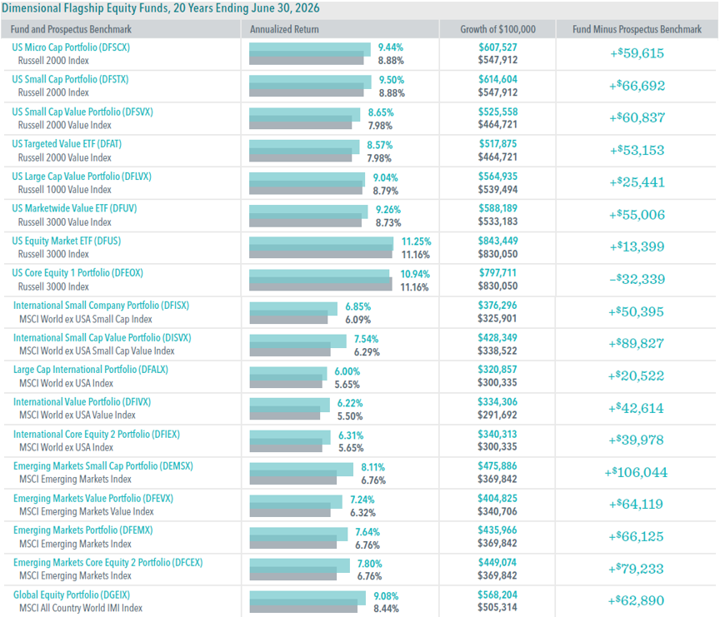
Most of the funds you have are on this table. A few don’t have a long enough track record. Perhaps once they do, we’ll produce an update. Considering how the rest have done, we like their chances.
Want to nerd out even more? Give us a buzz. We can talk about this stuff all day!
Cheers,
Your Great Oak Team